

My Rehoboth Beach Independent Film Festival Journal - Part 3

Rehoboth Beach Independent Film Festival
Rehoboth Beach, DE
November 10-14, 2010
Some more notes I jotted down after Amy and I returned home from this four-day film festival in Rehoboth Beach, Delaware...in this installment, the cinematic adventures conclude (breathe a sigh of relief)!
DAY THREE: Saturday, November 13
Amy and I got up early so we could catch a bite to eat at Dunkin' Donuts before our first screening that day, which was at 10:30 a.m. There, at the DD located at the Midway Shopping Center, we had a nice chat with a lonely widower who had lost his wife just three months ago. He said without his beloved, his home had become just a house. Then when Amy went to the bathroom, he asked how long we had been married. When I replied that we weren't married and lived separately, he quipped, "Well, you know what they say; women are like cockroaches - once they move in, you never can get rid of 'em!" (He might have had a valid point, but I think he would have welcomed that kind of home invasion!)
Then, amped up by ample amounts of coffee and flatbread sandwiches, we were ready to take on our first three-movie day.
*********
Client 9: The Rise and Fall of Eliot Spitzer
(Alex Gibney, USA, 2010)

My Movie Scorecard: A+
Life Lessons Learned From This Film: In America, sex and politics are a toxic cocktail, whereas in Europe, this mixture is elixir - and might actually get you elected!
Watch the Client 9 trailer.
I really wanted to see this because I'm a fan of both Eliot Spitzer (and his new CNN show Parker Spitzer - which I tend to watch more than MSNBC for news now) and director Alex Gibney.

"Parker Spitzer": Co-hosts Eliot Spitzer and Kathleen Parker
OK, the so the former New York Governor and State's Attorney turned political-talk-show-host had sex with prostitutes - and Clinton got a blowjob in the Oral Office - big (sometimes) fucking deal, right? Who cares? That's just a matter between him and his family. Forgotten is how Spitzer predicted the 2008 Wall Street meltdown and tried to correct its unregulated excesses when, as "the Sheriff of Wall Street," he prosecuted crimes by some of America's largest financial insitutions and most powerful executives. Who's laughing now? Not the American public. Not dispossessed homeowners. Not wiped workers whose 401Ks were wiped out by the stock market crash. Long after his tawdry tart sold her stories to the tabloids, Spitzer's insights to a problem that won't go away are still valuable, while the scandal sheets have returned to the next Page 3 Girl or disgraced politico.
And Alex Gibney? Alex Gibney is my hero. No, really. He's the best American documentarian working today, bar none. Gibney has produced award-winning films for Jigsaw Productions (the company he founded in 1982), and his trophy shelf boasts an Oscar (for 2007's Taxi to the Dark Side), an Emmy, a Peabody, the duPont Columbia Award, and a Grammy. An accomplished writer as well, Gibney blogs for the Atlantic Monthly and contributes regularly to the Huffington Post when not sitting in the director's chair. I had never seen one of his films before 2008, but now I've seen them all, and want to see still more!

Oscar-winning documentarian Alex Gibney
Michael Moore may have changed the Documentary Dynamic, popularizing a genre that only hovered in the shadows or on PBS (mainly thanks to Ken Burns) before Bowling for Columbine and Fahrenheit 9/11 took it to the cineplexes, but Gibney - along with Charles Ferguson (whose No End In Sight - the best doc on the Bush Administration's "war of choice" in Iraq - was executive produced by Gibney, and whose Inside Job is essential viewing for anyone who wants to understand Wall Street's recent financial meltdown) - has overtaken his fellow documentarian by focusing on the ideas at hand and not the player. (As a director, Moore has gotten lazy in his last two films Sicko and Capitalism: A Love Story, falling back on his schtick of Director As Subject-and-Provocateur; he's run out of ideas and resorted to the tried and true of on-camera surprise attacks and staged crowd-pleasing stunts, like draping the New York Stock Exchange with crime scene tape. It's ha-ha funny, but the thrill soon dissipates; there's no gravitas there, only cheap laughs. I tend to side with Moore on the issues, but as a documentarian he merely tells the "already converted" what they want to hear; I wish he'd go the distance and make compelling docs that convert the undecided as well.)

Moore is less
Client 9 was one of three new films directed by the prolific Gibney that were playing at this year's festival (the others were Casino Jack and the United States of Money and his sumo wrestling segment in Freakonomics). (He's also currently working on docs about Ken Kesey, Lance Armstrong, and Al Qaeda - read more about Gibney's busy year in Jon Anderson's excellent NY Times profile "Not Afraid To Follow the Money.") And this one may be his best yet, though it's doubtful that its sophisticated subject matter - I'm talking Wall Street derivatives and sub-prime mortgages, and not the sex! - will translate into box office success. But as Gibney himself has said, he thinks documentaries today are not only better made, but have taken over the truth-telling function our increasingly polarized free press (e.g., Fox News on the right, MSNBC on the left) has largely abandoned. He doesn't care about box office; he cares about spreading the word, which is why he founded Jigsaw Productions in 1982 to produce just these sort of films.

Gibney's "Gonzo" (2008)
I first discovered Gibney at the 2008 Maryland Film Festival, where I was working for the festival as a cameraman videotaping director intros and Q & As. Gibney was there to present his doc Gonzo: The Life and Work of Dr. Hunter S. Thompson, which I absolutely loved (and Gibney was very kind when, during the Q & A, he politely deflected Mr. Johnson's idiotic question "Was Hunter Thompson a real medical doctor?" I think Mr. Johnson thinks Julius Erving was also a practicing M.D.!).

"WR: Mysteries of the Organism" screened at the 2008 MFF
Gibney was also there as a Guest Programmer, and I instantly liked him when I saw he had picked Dusan Makavejev's WR: Mysteries of the Organism (an exploration of the connections between sexuality, leftist politics, and Wilhelm Reich's orgone energy theories.) I had been fascinated by Yugoslavian filmmaker Makavejev's WR ever since an iconic still from it graced the cover of Amos Vogel's cult tome Film As a Subversive Art (the one book I recommend without reservations to all film lovers).

My kinda subversion
I blathered something inane (as per usual) to Gibney as he waited in the wings before addressing the audience at the Charles Theater, but we were both too focused on our duties-of-the-moment for more idle chit-chat. Now I wished I had talked to him more, because I didn't fully appreciate his gifts until I sought out his Oscar-nominated Enron: The Smartest Guys in the Room and was blown away by both the style and the depth of research. I subsequently caught his 60-minute doc short The Human Behavior Experiments (2006) on cable TV's Sundance Channel and his Oscar-winning Taxi to the Dark Side (2007), an in-depth look at the torture practices of the United States in Afghanistan, Iraq and Guantanamo Bay, focusing on an innocent taxi driver in Afghanistan who was tortured and killed in 2002.

Gibney's Oscar-nominated "Enron: The Smartest Guys in the Room" (2005)
Taxi established the key to Gibney's direct documentary approach: it focuses on the protagonists, the people responsibile for perpetrating abuses more than the victims. As Gibney himself has said, "I'm more interested in the perps than the victims. I'm interested in the victims, of course, but more interested in understaning the mind-set that allows people to commit or justify these acts, because that's the only way to prevent them in future."

Gibney's Oscar-winner, "Taxi to the Dark Side" (2007)
In Client 9, that means Eliot Spizter is front and center (another reason I like Spitzer: he doesn't shy away from this unflinching look at his scandal - the former "paragon of rectitude" takes his lumps and tackles it straight-on, like a humbled man). Not to mention all his Wall Street and New York political foes (and they are legion) - many coming forward for the first time. And that's the key to its success and its unbiased (if any doc can be said to be unbiased), fair and balanced approach.
Moreover, whereas Gibney could have just made a film about the convergence of sex, power and hubris - documenting a mighty man's meteoric rise (don't forget many people believed Spitzer was on his way to becoming the nation's first Jewish president) and calamitous fall resulting from a foible of flawed human nature (after all, it's the stuff of classic tragedy, dating back to the Greek stage) - that narrow focus doesn't really interest him. Instead, he questions - presenting just the facts - the timing of it all, suggesting that Spitzer may have been targeted by the many powerful foes he made on The Street. Yes, Spitzer was the cause of his own downfall, but there were plenty of eager hands ready to help that descent along, as Gibney pointed out in an interview with the NY Times' David Carr. Like Kenneth Langone, the co-founder of Home Depot and a former director of the New York Stock Exchange who was assailed by Mr. Spitzer for signing off on a huge $140 million deferred compensation pay package for Dick Grasso, CEO of the "nonprofit" New York Stock Exchange, and who seemed to know a lot about the governor’s day-to-day life.
“How did Kenneth Langone know that Spitzer was in line at the post office sending money orders to the escort service?" Gibney asked, adding, "Whenever my conspiracy gene kicks in, I have to check myself, but I doubt that Langone even knows anyone who goes to the post office. Somebody was watching him."
Another fascinating character in the film is Republican "wack job" swinger-and-mudslinger Roger Stone - ostensibly a "Republican strategist" but in reality a "Dirty Tricks" specialist. Stone's credo of "Admit nothing, deny everything, launch counterattack" are truly words to live by for anyone involved in politics; he certainly followed the rules when it was alleged he was behind the infamous "Willie Horton" ad (Stone credited the ad to Lee Atwater). Despite coming off as somewhat of a clown (albeit a charming one) in Client 9, Stone surprisingly liked the film. He even gave Gibney a plug on his official web site The Stone Zone (www.stonezone.com), though he insists that Eliot Spitzer kept his knee-high black socks on during sex with call girls despite Gibney debunking the claim - in fact, that seems to be his main beef with the documentary (the Black Sox Scandal!).
Watch Roger Stone's Client 9 review.
One thing that struck me watching Client 9 is how it tied in so well with other Gibney-associated projects I had seen. For example, the scenes detailing Wall Street and political corruption echo similar accounts in Casino Jack, Enron: The Smartest Guys in the Room, and Charles Ferguson's Inside Job (which he executive-produced). And, as we would find out later that night in his segment in Freakonomics about corruption in the Japanese sport of sumo wrestling, he even tied in the way sumo stats and standings can be tweaked just like Wall Street and banking industry account balances. Zeitgeist!
By the way, if you can't wait to see Client 9 in theaters, you can try catching it on demand or iTunes, where it was "pre-released" on October 1, 2010.
Amy and I had post-poned seeing Gibney's other full-length documentary playing at the festival , Casino Jack and The United States of Money, because we figured this earlier 2010 release (which has inspired the Hollywood remake Casino Jack, starring Kevin Spacey as Abramoff) was probably available on DVD by now and we could catch it later via NetFlix. We did and - hello! - turns out the Jack Abromoff lobbying scandal has a Rehoboth Beach connection!
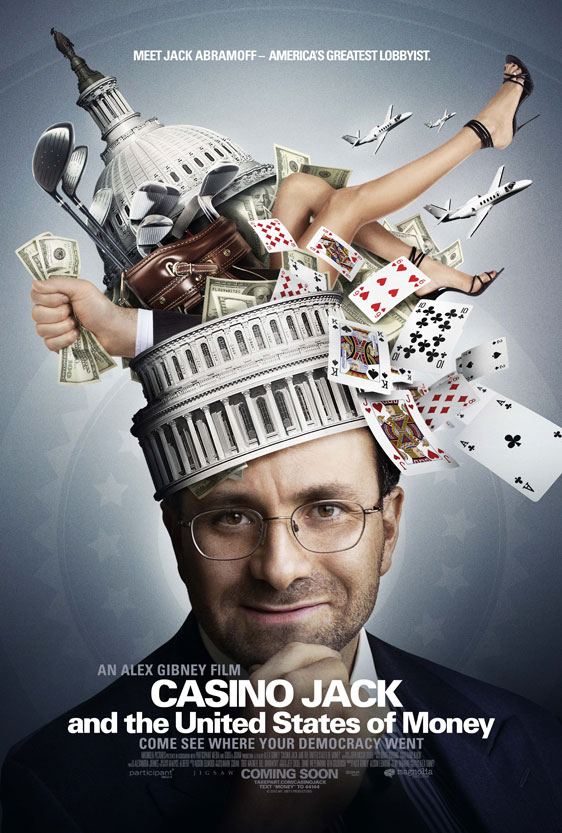
Gibney's "Casino Jack" (2010) was also screening at the film fest
Abramoff, through his cohort (and erstwhile staffer for former Speaker of the House and Dancing with the Stars contestant Tom DeLay) Mike Scanlon - who is still a part-time Rehoboth Beach lifeguard - used the city to establish a fake corporation (American Independent Council) in which to filter money.
Seems that beachcomber David Grosh, a former lifeguard (Rehobo's 1997 Lifeguard of the Year, in fact!), was paid $2,500 by his friend Scanlon to head a phony "research organization" in Rehoboth, but it only functioned to funnel large sums from Indian tribes back to Mr. Abramoff and his law firm. A few shots of Rehoboth Beach are used and a few interviews with the incredulous Lifeguard CEO Grosh ("I asked him what do I have to do and he said, 'Nothing'!") are conducted there, as well. No wonder Gibney sported his Rehoboth Beach Lifeguard t-shirt at the Maryland Film Festival!
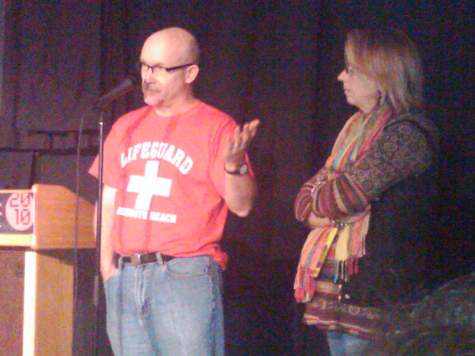
Alex Gibney, in Rehoboth Beach lifeguard t-shirt, at the Maryland Film Festival
Hats off to RBIFF for programming this film there this year; timing is everything!
Watch the Casino Jack trailer.
Of course, the other great part of Gibney's Casino Jack documentary is seeing clips from one-time Hollywood writer-producer Abramoff's Cold War proxy action film, Red Scorpion (1988), which starred Dolph Lundgren as a Soviet KGB agent sent to Africa to assassinate an anti-Communist revolutionary leader, who was based on Abramoff's real-life warlord pal Jonas Savimbi, notorious leader of Angola's UNITA rebel group.
Watch the Red Scorpion trailer.
***
After the movie we had to rush out of the theater to get to our next movie, a special added-on screening for the already twice sold-out Nora's Will.
*********
Nora's Will (Cinco Dias Sin Nora)
(Mariana Chenillo, Mexico, 2008)

My Movie Scorecard: A
Life Lessons I Learned From This Film: There's an orthodox Jewish community in the uniformly Catholic country of Mexico - go figure! Also, the Catholic and Jewish faiths are surprisingly alike in their abhorrence of suicide and view it as a sin that affects burial rights. Also, I could never be an Orthodox Jew because that sausage-and-ham pizza that Nora's ex-husband orders during Seder looks just too yummy to pass up!
This was another Amy pick, and a good one! As expected, Nora's Will was a standing room only affair and we literally got the last two seats in the front row, once again (a la the A Matter of Size screening) sitting six feet away from the screen. In fact, the theater was so packed that a volunteer plopped two folding chairs next to us in order to seat two insistent moviegoers who acted like their lives depended on seeing this Funeral Genre dramedy about a Mexican orthodox Jewish woman's funeral arrangements following her suicide at the start the "High Holy" Jewish Holidays. The film's Spanish title is literally "Five Days without Nora," and that's the period the film covers, which is significant because timing (or "ripeness") is of the essence in Jewish burial rites, which insist that bodies must be buried within 48 hours.
Wow, first the Rehoboth Beach film festival featured an Israeli film about Jewish sumo wrestlers who train under a ex-pat Japanese Jew restauranteur. Now it presented a film about orthodox Jewish burial rites in Mexico. Talk about narrow niches!
This was a delightful film about about family, compromise, and getting along with others when cultures and religious beliefs clash. It's ultimate philosophical spirit can be summed up in a Paul McCartney song: "We Can Work It Out." Nora's Will reminded me that films about death and death rites constitute a genre unto themselves (I'm thinking Death at a Funeral, Juzo Itami's The Funeral, Japan's recent Oscar winning Departures) and this is an excellent added entry. The humor is subtle, not over the top, as suits a film about the dignity of death and respecting the divergent will of opposites (estranged husbands and wives, Catholics vs. Jews, modern vs. traditional, the young vs. the aged).
Watch the Nora's Will trailer.
Our final movie that day was a late-night screening of the documentary Freakonomics. Since we had a lot of time to kill, we had lunch at Hobos Restaurant and Bar on Baltimore Avenue, which - despite its pretentious-sounding billing of "Eco-Global Fusion Food" - is actually one of our favorite restaurants, albeit a pricey one (but hey, you get what you pay for - in this case delicious and exotic food!). The last time we were there, Amy got codfish, which sounds un-exotic until you add its sauce - blueberries and bacon! (Insert Homer Simpson "transcendent" drooling sound here.) Today we went cheap, Amy scoring some Buddha's Garden Salad with tons of avocado (her favorite topping!) and me tackling the biggest, most-rib-sticking Greek Salad I've ever had. I didn't eat again that day.
Back at the Crosswinds Motel, we watched an MSNBC TV marathon of specials about serial killers, child molesters, prison gangs, and kookie New Age polygamous sex cults. Needless to say, it kept our gastronomical appetites firmly in check.
Later in the early evening, we returned to the RBIFF Big Tent where, as part of this year's "Country Spotlight on India" celebrations, there was free henna-painting and a Bollywood fashion show and dance performance. Amy was eager to get her hand henna-ed, even though it meant not washing her hands for a couple of hours (always problematic when you pee as often as she does!); but art, in this case, won out over bladder control.

You gotta hand it to Amy!
Watch Amy get her hand henna-ed.
We had to rush to catch our next film, Freakonomics, so we could only catch a bief glimpse of that evening's Bollywood fashion show, as shown below.
Watch the Bollywood Fashion Show at the Rehoboth Beach Film Festival.
*********
Freakonomics (2010)
(Alex Gibney, Rachel Grady, Heidi Ewing, Eugene Jarecki. Seth Gordon, Morgan Spurlock, USA, 2010)

My Movie Scorecard: B-
Life Lessons Learned From This Film: What looks good on paper doesn't always translate to film
Watch the Freakonomics trailer.
For those who believe in strength in numbers, I got news for you: numbers lie. Surprisingly, this "Super Doc" of multiple directors with the toppermost pedigree - Oscar-winning Alex Gibney (Taxi To the Dark Side), Morgan Spurlock (Super Size Me), Rachel Grady & Heidi Ewing (Jesus Camp, 12th & Delaware, The Boys of Baraka), Eugene Jarecki (Why We Fight), and Seth Gordon (The King of Kong) - was our least favorite entry at the festival. Parts were good, but the sum total just didn't add up. Truth be told, neither Amy nor I had read the best-selling book, by economist Steven D. Levitt and author Stephen J. Dubner, that it was based on - but I don't think I'd want to anyway. Onscreen they come off as kind of smug and their approach of applying statistics and incentives to analyze human behaviors yields controversial (at best) and unconvincing (at worst) conclusions.
Its basic principle is that numbers don't lie, but I found the film to be, overall, unconvincing. One need look no further than the Enron scandal, or more recently to the Wall Street and sub-prime mortgage loan meltdowns, to see that cooked books and inflated earnings do indeed lie. (We won't even go into sports records with their various asterisks, like baseball home run records augmented by steroids!).
Of the various segments, Gibney's is naturally the strongest. Here, Gibney "looks behind the fragile facade of sumo wrestling and exposes uncomfortable truths about this ancient and revered sport" - that's fancy film program guide talk for cheating. And cheating becomes prevalent when Japan's organized crime syndicate, the yakuza, gets involved - as invariably they are. When I later mentioned this to my Japanophile pal Dave Cawley, he loaned me a great Tuttle book on sumo wrestlers (thanks Dave!). (I love sumo wrestling; I just wish they had a featherweight class so I could get involved - skinny guys wearing thongs and pushing each other around, now that's entertainment!)
We also enjoyed Morgan Spurlock's segment on names, in which he muses whether being dubbed Sheniqua, Tripp, or Moon Unit has any effect on one's prospects. The conclusions are pretty obvious and common sensical - I mean, do we really need stats to understand that somebody named Mohammed going through airport security is gonna raise more eyebrows than someone named Skippy? Like Michael Moore, the personable Spurlock does not shy away from the camera and is heir-apparent to Moore's style of Provocateur Auteur As Subject filmmaking, albeit with a much lighter, more humorous edge.
I love Rachel Grady and Heidi Ewing as a documentarian team, but their segment on whether money can help motivate underachieving kids into improving their grades is unconvincing. The one black kid they focus on is a great find - he's charming to a fault - but one is left with the idea that giving $50 to junior high kids (who already have cell phones and gaming stations) is chickenfeed. And the skater punk white trash kid they follow around...well, I have a feeling his only option is gonna be an early death, either from the streets or on a battlefield - the armed forces being the only conceivable "honest" employment option for him after he (eventually) drops or flunks out of school. Amy and I were surprised to see E's on his report card ("What's an E?" we wondered: Excellent or Execrable?); not having kids, we missed out on the disappearance of F's as school systems replace them with wimp letters like "I" for Incomplete. But then we're from a different generation, one in which we we were taught that 1 + 1 = 2 and not 1 + 1 = E.
But the weakest segment was one that looked the most promising: Eugene Jarecki's investigation of Levitt's provocative theory about why crime rates dropped in the early '90s. As we've seen locally in Baltimore with homicide and rape statistics around election time, these numbers are almost always tweaked for political purposes. Nothing new there, though Levitt and Dubner go one further by suggesting that crime in the 1990s decreased because "born criminals" decreased - as a result of the increased availability of abortions for unwanted pregnancies following the U.S. Supreme Court's landmark 1972 Roe vs. Wade decision. Kids born after 1972 would have graduated from juvenile status to legal adult age sometime in the '90s, according to this statistical theory, and thus been added to the adult crime statistical rolls. It's a pretty rad idea: because "mistakes" didn't grow up unloved and unwanted in economically challenged, single-parent homes, they didn't turn to crime and violence as an outlet for Mommy not loving them. As our favorite Star Trek Vulcan Spock would say, the idea is: "Fascinating." No, our biggest quibble with this segment was Jarecki's decision to use Melvin Van Peebles as a "celebrity" voiceover narrator. Whatever other gifts Mr. Van Peebles may possess as a director-auteur, public speaking isn't one of them. Neither Amy nor I could understand what he was saying, as he sounded like he was talking with a mouthful of marbles. No one will ever confuse the mush-mouthed Melvin with James Earl Jones, let's put it that way! Jarecki lost me with that call; the only worse choice might have been using Diane Rehm.
DAY FOUR: Sunday, November 14
We had time to catch that morning's screening of the Israeli POV war film Lebanon, which my librarian friend Emily had seen the day before and raved about, but it was such a nice sunny day out, we opted instead to shop at the nearby Rehoboth Avenue boutiques (Amy can never have enough jewelry or zipper pulls!) and, later, check out the Tanger outlet stores (there's even one for QVC!) on our way home. At a Midway Shopping Center thrift store, I managed to score a spiffy jacket, sweater, and a video of Karen Gordon's 1987 NYC street performers documentary No Applause, Just Throw Money for $7! I also found what I thought were laserdiscs of the entire Ralph Bakshi-animated Lord of the Rings trilogy for a quarter each, but it turns out they were an obsolete media format called the "RCA SelectaVision VideoDisc System" - a Capicitance Electronic Disc delivery platform for home video marketed by RCA from March 1981 through June 1986.
And, naturally, Amy found a bargain in one shop, scoring an off-season knock-down on a spiffy looking wool cap, as shown below.

"I love my new hat!"

"How do you like me now?": A view askew of Amy's new hat

Amy introduces her new hat to her henna hand
The People have Spoken: The Results Are In!
The RBIFF really pushes ballots on people, emphasizing how important it is to pick favorite films in different categories. The results of all those audience ballot box stuffings are the "Audience Awards." This year's winners were India's Like Stars on Earth (Best Debut Feature), the Czech Republic's Bride Flight (Best Feature), and Soundtrack for a Revolution (Best Documentary) - which is fine by us, because we had no interest in seeing any of them! Knock yourself out people!
And that, as they say, is a wrap. See you next year Rehoboth Beach Independent Film Festival!
Labels: alex gibney, client 9, eliot spitzer, film festival, freakonomics, morgan spurlock, nora's will, rehoboth beach, rehoboth beach independent film festival, sumo wrestling
posted by Tom Warner, Almost Hip Guy @ 9:53 AM
124 comments


